
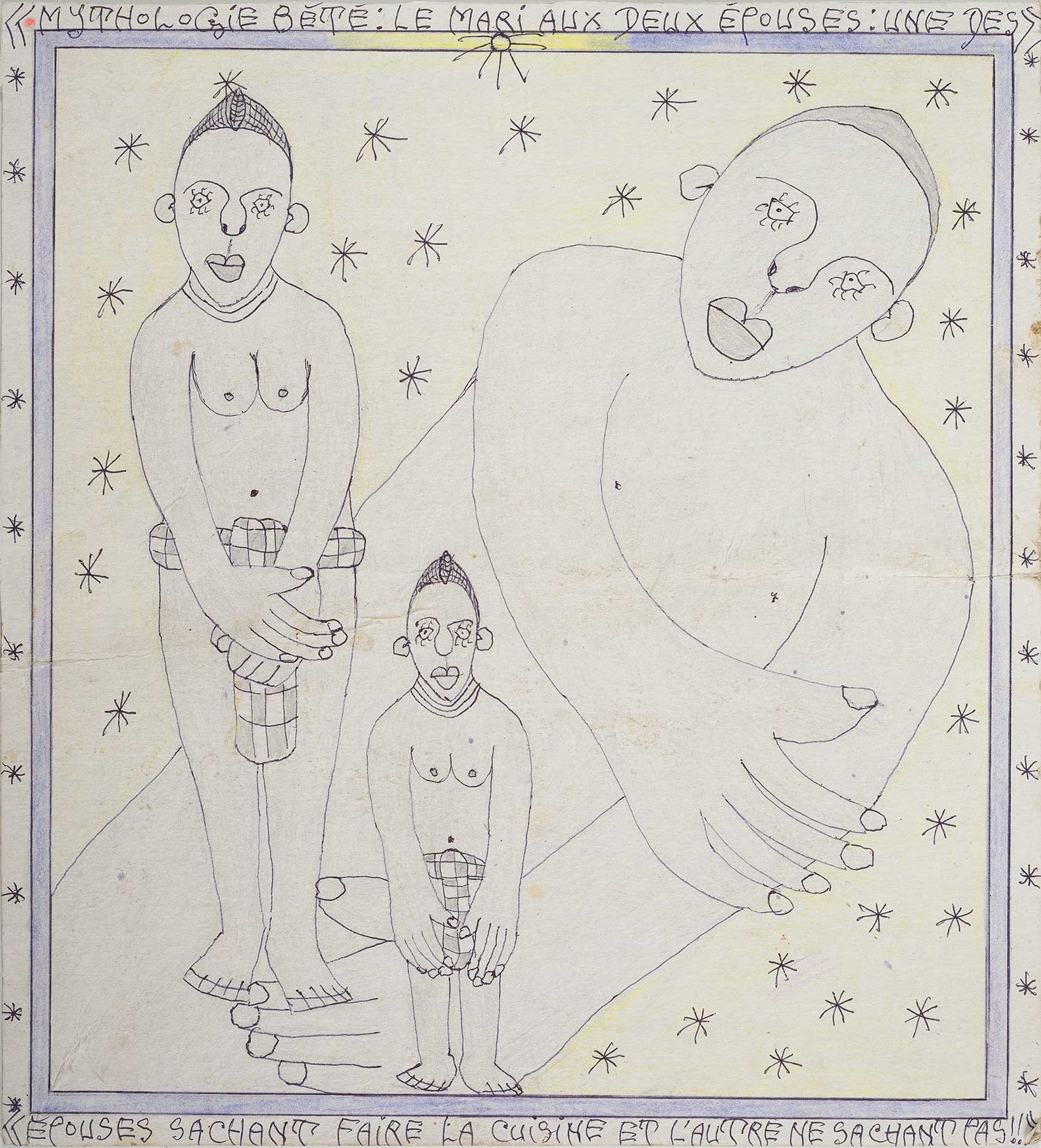
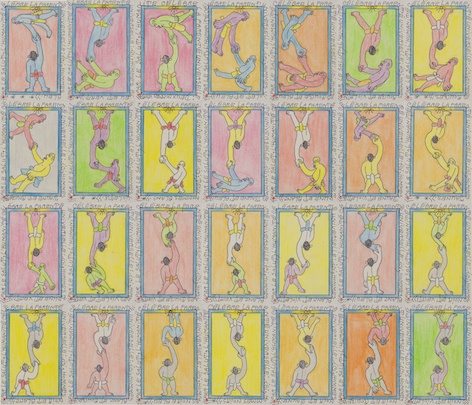
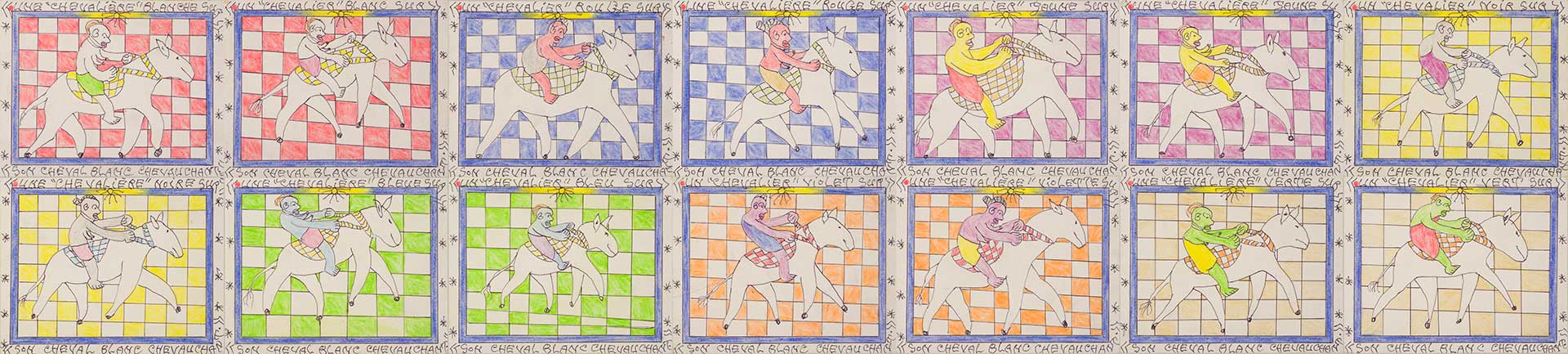
All of these drawings are part of an expansive conceptual cycle titled “World Knowledge”, through which Bouabré sought to document and preserve the totality of human understanding as he perceived it. Each drawing is not an isolated artwork but a component of a global system of meaning, where image and text function together as tools of interpretation and transmission. In addition to his visual practice, Bouabré developed a remarkable linguistic project: a 448-letter universal Bété syllabary. This writing system was designed to transcribe the oral traditions of the Bété people, transforming spoken heritage into a written form and asserting the value of indigenous knowledge systems within a global context. His visual language is expressed across approximately 1,000 small cards, executed primarily with ballpoint pen and colored crayons. These compact works combine symbolic imagery and handwritten text, each carrying a distinct didactic, philosophical, or divinatory message, often reflecting on themes of life, history, morality, and cosmic order.
Bouabré’s practice occupies a unique position between art, writing, anthropology, and spiritual inquiry, blurring the boundaries between documentation and creation. His work proposes an alternative model of knowledge, where image and language are inseparable and where artistic production becomes a form of universal encyclopedic thinking. Many of his drawings are preserved in major collections, including the Contemporary African Art Collection (CAAC) of Jean Pigozzi, one of the most important archives of contemporary African art. An emblematic work is also held in the L’appartement 22 collection in Africa: “Une divine peinture relevée sur le corps d’une mandarine jaunie” (1994, Abidjan), a piece that exemplifies his synthesis of symbolism, observation, and poetic narration. Through his lifelong project, Bouabré established a unique and deeply influential body of work that continues to resonate as a radical rethinking of writing, image-making, and the construction of knowledge within African and global art histories.