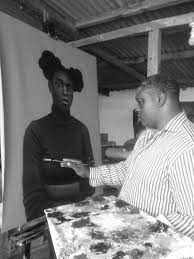
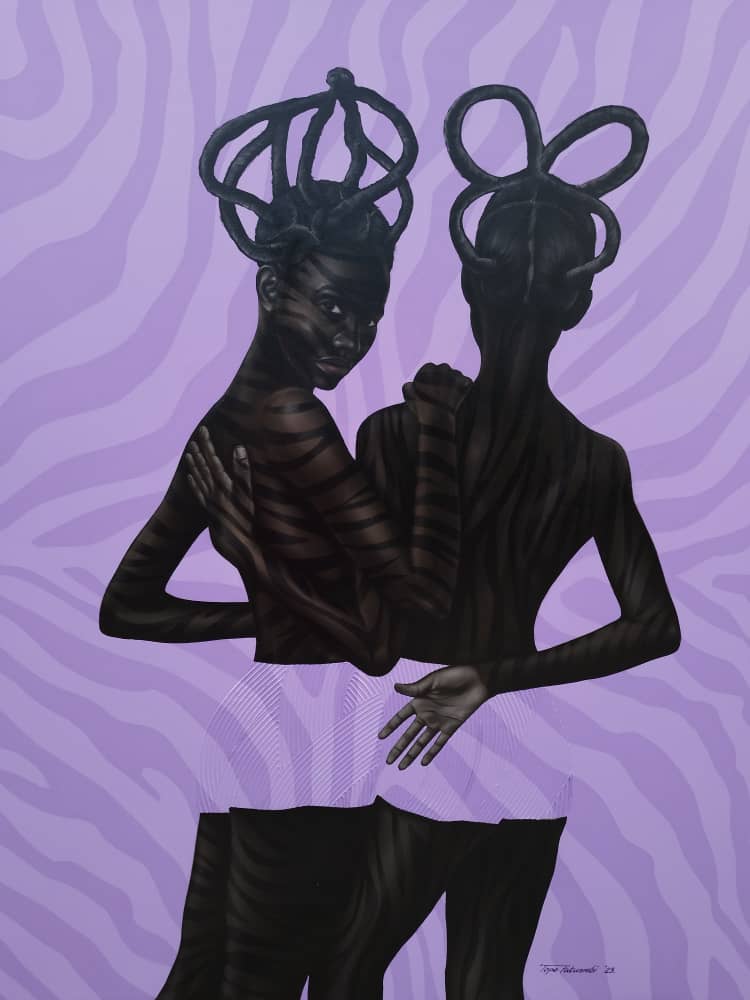
Tope Fatunmbi was born in 1975 in southern Nigeria to educator parents in the 1970s, and is currently based in Ibadan. The artistic practice of Tope Fatunmbi focuses primarily on portraiture, with a particular emphasis on the representation of Yoruba women’s hairstyles in southern Nigeria. Through these images, the artist constructs a visual discourse aimed at empowering and elevating women, acknowledging their essential role as the pillars of Yoruba society and, more broadly, as central figures within social and cultural structures. His compositions are defined by optical and perceptual patterns, creating complex, fluid, and highly dynamic surfaces. These flowing, lush motifs evoke a sense of freedom and movement, reflected in the hairstyles themselves, which function not only as aesthetic expressions but also as cultural identifiers and markers of tribal belonging.
Within this visual system, however, a strong conceptual tension emerges. The Op Art-inspired patterns, while celebrating beauty and rhythm, at times seem to dissolve or obscure the female figures, suggesting a subtle form of visual disappearance. This ambiguity introduces a critical layer to the work, pointing to how these women, despite their central role in society, may still be overlooked or underappreciated within broader cultural narratives. In response to this idea, Fatunmbi actively reinforces the presence of his figures by rendering their bodies and garments with thick, textured paint, asserting their physicality against the flatness of the canvas. This material density gives the figures a sense of weight, presence, and corporeal strength, allowing them to emerge forcefully from the pictorial surface.
In doing so, the women portrayed are not only made visible again, but are also elevated beyond the two-dimensional constraints of painting, acquiring a near-sculptural presence. The contrast between the fluid optical patterns and the material solidity of the figures becomes the core of his practice, articulating a dialogue between presence and erasure, surface and depth, ornament and identity. Through this approach, Fatunmbi expands his exploration beyond aesthetics, engaging with deeper questions surrounding female representation, cultural visibility, and social recognition, transforming each work into a space where identity, memory, and visual perception intersect.