
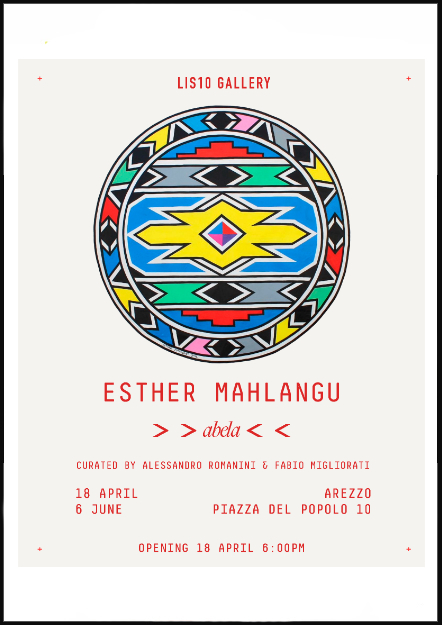
The title Abela, which in the Ndebele language evokes the ideas of “sharing” and “transmission,” introduces the core of the artist’s practice: a visual language deeply rooted in tradition, yet continuously renewed through its engagement with the present. Since the early stages of her career, Mahlangu has been committed to preserving and reinterpreting the decorative motifs of Ndebele culture, historically associated with domestic mural painting and the intergenerational transmission of knowledge among women.
Her work is distinguished by the ability to translate these visual codes—defined by rigorous geometry, flat color fields, and vibrant tones—into contemporary contexts, from canvas to international exhibition spaces, without compromising their symbolic and cultural significance. In this transition, the manual and ritual dimension of her painting remains central, while her visual language opens to a global audience.
Throughout her career, Mahlangu has played a pivotal role in redefining the relationship between traditional and contemporary art, bringing a culturally rooted aesthetic into the international art system and collaborating with major institutions and global projects. Her work thus stands at the intersection of cultural memory, identity, and formal innovation.
Abela emerges as a reflection on the value of knowledge transmission and its ability to move across contexts, generations, and geographies, while retaining its expressive power. The works on view highlight the continuity of a visual language that evolves without losing its deep connection to its cultural origins.